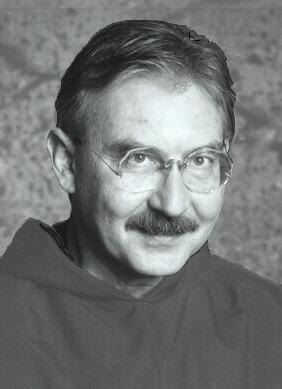
Father Joseph Neilson died on March 17
th; leave it to the Irish to die on St. Patrick’s Day.
Joseph was born on 28-Dec-32 in New York City to Frederick Neilson & Josephine Clancy.
His father died when Joseph was young, and his mother supported her two sons by working as a cook for a wealthy family in Manhattan.
After being taught by the Christian Brothers in primary school, he attended Fordham.
“My brother George was away in WW II, and while I was at home alone and sick, I picked up Therese’s Story of a Soul.
That was my discovery of the Carmelite life.”
He was received into the Carmelite order in San Antonio in September of 1951.
Early in the morning of May 15
th Brother Joseph and his fellow novices closed down our novitiate in San Antonio and headed north to Little Rock.
They arrived at Marylake, the site of our province’s new novitiate around sunset.
Felix greeted him at the back porch, took him into the chapel and invited the novices to view the rest of the monastery while Brother Victor prepared supper.
Joseph was lucky to get a separate cell, because when the new group of postulants arrived from Mt. Carmel Center in Dallas on June 16
th, the new boys spent their first evening at Marylake arranging a large room downstairs into a dormitory.

Brother Joseph was the first novice to make his profession at Marylake on the Feast of St. Thérèse in 1952. He had taken the religious name Joseph of St. Thérèse. Joseph and Sam Morello were sent to Rome to study theology and were ordained there on 29-Apr-62. His first assignment was at Marylake, and in 1966 he was elected 2nd Provincial Councilor and Novice Master. In 1969 he was sent to be the new superior of our Houston community. When Houston was closed, he was sent back to Marylake. He spent 1975 as a hermit in Placid’s hermitage on the back of Marylake’s property. In 1978 he was again appointed Novice Master and prepared John Magdalene for profession. Father John preached Joe’s funeral Mass at Marylake on March 21st.
Joseph loved to run. After running for a year from Marylake to our Nuns in Little Rock (13 miles each way) he ran the Boston marathon. He was always in demand by our nuns throughout the province (and beyond) for conferences on Carmelite history and spirituality. His spiritual conferences would often last all morning or afternoon. Our nuns soon learned to attend in relays. A few would slip out while Joseph was looking up something in a book; then slip back in after completing their chores while the next group relayed out.
In the 1970s, Joseph took on the cause of protesting abortion. He became the spiritual advisor of groups picketing abortion centers in Little Rock,  then in Oklahoma. The Pearson Foundation, concerned with pregnancy counseling, named him their national Chaplain in St. Louis in 1984. He set up White Rose Counseling Centers in Texas and Arkansas. Being born on the feast of the Holy Innocents, he felt called to this apostolate.
Abba House was among the first ministries developed in the Little Rock diocese to give women an alternative to abortion. The idea for Abba House came from Father Joseph, who had begun praying outside abortion clinics in the city. By May 1979, Nielson began bringing homeless pregnant women to the home of Patricia Grabher for shelter. Assisted by several volunteers, the women received care through their pregnancies and help finding a place to live after giving birth.
Before long, the ministry outgrew the small Grabher apartment. Volunteers realized that a larger facility was needed to serve them. They found a rental house for sale on South Oak Street. Fr. Joseph approached Bishop McDonald about purchasing the property, and the diocese bought it through a donation from the Wrape Family Foundation.
Abba House soon became more than the Grabhers could handle. In January 1982, the volunteers, led by Nielson, asked Bishop McDonald to write to Mother Teresa of Calcutta to ask for her sisters to take over the shelter. Mother Teresa wanted to visit Little Rock to see Abba House herself before agreeing to send her sisters.
 Mother Teresa arrived in Little Rock on June 2, 1982, and stayed with our cloistered Carmelite nuns. The following day, Bishop McDonald took Mother Teresa to Abba House. After touring the shelter, she addressed the crowd outside, saying, “Gold and silver I have not. That which I have I will give you. I will send you my sisters. Together with you, we will make something beautiful for God.”
Later that day, Bishop McDonald and Mother Teresa led a prayer service at Ray Winder Field. Addressing the 5,429 people at the event, Mother Teresa pleaded with pregnant women who were considering abortion to let the Missionaries of Charity take care of their children. As promised, four Missionaries of Charity arrived in Little Rock to take over the ministry of Abba House in July 1983.
Joseph’s I.Q. was genius level. I never realized how encyclopedic his knowledge was until I examined the library of which he was in charge at Marylake. One would suspect a few areas of expertise would excel in the books he gathered for theology, history, scripture or spirituality. But poetry, art, music, and even the novels he collected for those sections of the library were superb. You could ask Joseph a question about anything from Elvis to Stephen Hawking, and though he might not have an immediate answer, he knew exactly where it could be found.  Not by a goggle search, for Joseph never took to the computer. But he knew where the answer was in a library book.
The old stereotype of the absent minded professor comes to mind when you notice how a brilliant mind like Joseph’s was quite incompetent when it came to practical matters. Growing up in Manhattan, Joe never saw the need to learn how to drive. But the day finally came when he asked one of the brothers to teach him. Noticing how one of the most difficult things to master was backing up, Father Joseph would drive the car around the large oval drive at Marylake –backwards. He reasoned that if he hit anything, it would not be anything serious, only a chicken house or milk barn. But he was a terrible driver. One of his great feats was ending up perched on top of a three foot tall concrete barrier in the middle of a Houston freeway, facing backwards. None could imagine how in the world he ended up there, but he did.
On 29-Nov-86, when Father was stationed at Mt Carmel Center in Dallas he was in a terrible automobile accident that damaged his brain stem. This severely affected his movement and his speech. From November to August he was in a Dallas Rehab Institute, and then sent to Tangram in San Marcos where he remained until he was able to move back to Mt. Carmel Center.
 In 2002 he was sent from Dallas back to Marylake where he carried on a prodigious career in spiritual direction. Speaking of moves, we Carmelite friars are always being moved about from one house of the province to another. Joseph was sent to be superior in Oklahoma City by Fr. Raymond in 1981. Joseph was so devoted to the vow of poverty, that he was able to make all his moves carrying everything he possessed in two suitcases and one handbag. I know of no Carmelite in modern times able to accomplish such a feat.
After a number of falls at Marylake, he needed to be moved to a nursing home in San Antonio in February of 2009. He accepted this unpleasant “assignment” with great resignation. In 2012 he was moved to Morningside Manor on Babcock Rd where he died at 4:20 am on Saturday March 17th. Leave it to the Irish to die on St. Patrick’s Day.
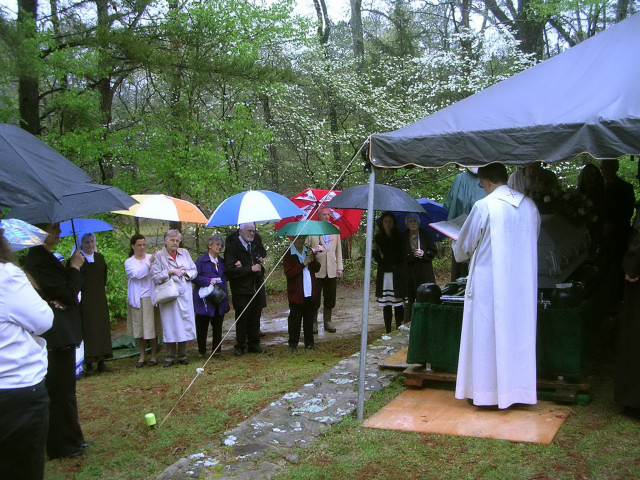
 A scriptural rosary was held at Marylake on the Tuesday night after his death. The Requiem Mass Wednesday morning was concelebrated by Fr. Luis Belmonte, pastor of our Basilica in San Antonio; Msgr. John O’Donnell & Tom Keller from the diocese of Little Rock, Fr. Jesús Sancho from Oklahoma City, Fr. John Michael from Dallas, Fr. Sam Anthony Morello & Fr. John Magdalene from Marylake, and Raphael Kitz. Fr. Provincial, Luis J. Castañeda was the principal celebrant, Fr. John Magdalene (Joseph’s only surviving novice) preached, and Joseph’s classmate in Rome, Fr. Sam Anthony led the graveside service at the provincial cemetery. Also attending was our province’s senior student from San Antonio, Br. Juan Guillermo. Pallbearers were Kevin & Dennis Lee, Robert & Bob Pilkington and Davíd Lira. May his soul, so beloved by so many, now rest in peace.

 Aloysius John Wrape Jr. 1924-2014., passed away in the early afternoon of the 2nd Sunday of Advent. It was the vigil of the Immaculate Conception. Al was a diehard Notre Dame alumni and fan. Rush Limbaugh. Al would put him on the radio each time I stepped into his car just to get a rise out of me. He was the ultimate toaster at parties, and loved to throw in a sermon with each table blessing. He raised five girls and two boys. When kidded about how many children he spawned, he’d always reply upon the one-liner, “It was all my pleasure.” In the fall of 1987, Al took me on a cruise to Alaska. He was a friend. He was more than a friend. I was always welcome as a family member in his house. He shared my love of the Monastery of Marylake, and always did what he could to keep us afloat. That meant arguing with our creditors and driving out here multiple times a week to keep our books in order. He saw the end coming. I was with him in September when Father Ralph anointed him. The seven kids gathered around their Mom Sunday, and he passed peacefully into eternity. May the angels lead you to paradise, Al.